
Hair Care & Hairstyle Ideas
Product Buildup in Hair: Signs and a Clarifying Reset Routine
Learn the visible signs of product buildup in hair, tell buildup from dry hair, and follow a gentle clarifying reset routine step by step.
By Glow Routine Life · Updated 12 November 2026
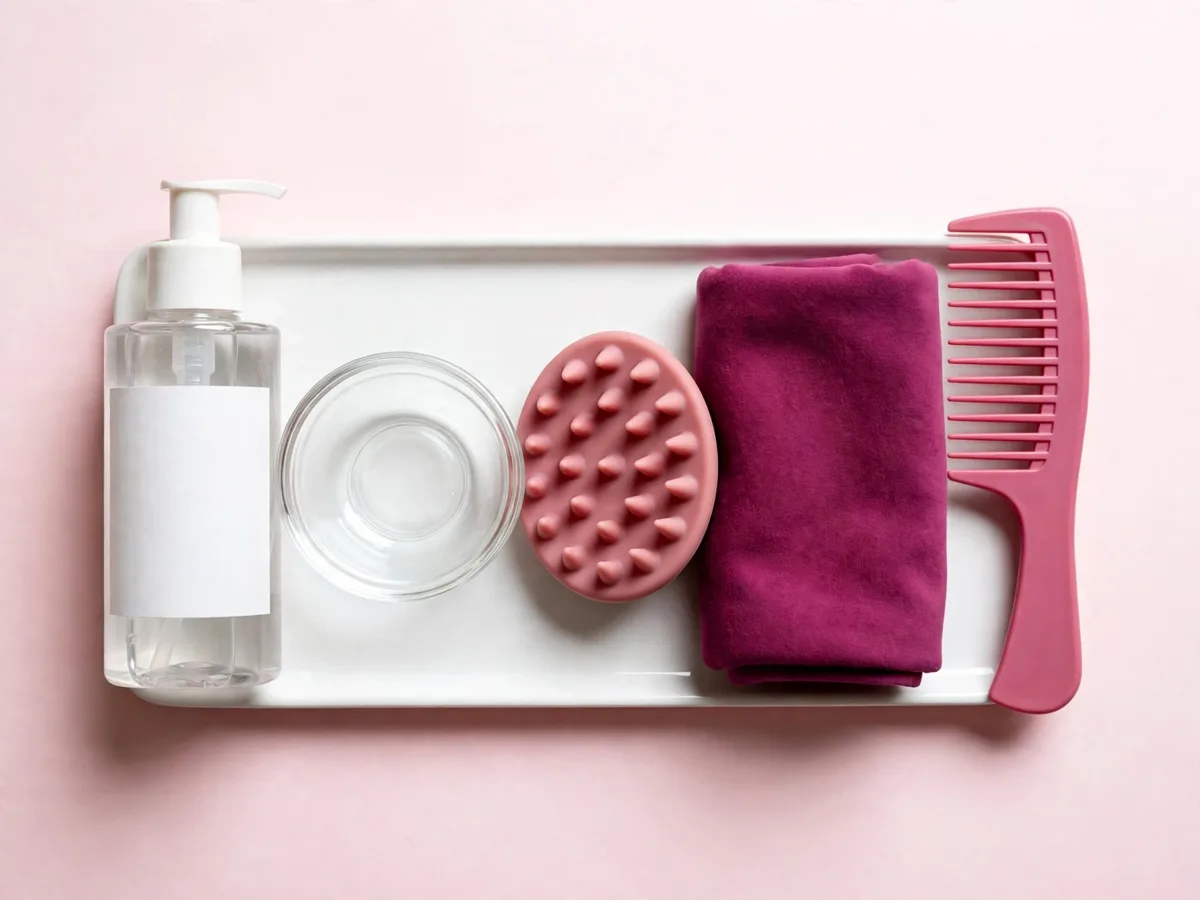
Buildup at a glance
Product buildup is residue from the styling and conditioning products you already use, and it collects where you apply the most. The way out is a slower wash: shampoo at the roots, rinse long, condition the lengths, and drop one product from the week.
- Check the roots first. Buildup shows up where you apply the most product.
- Run a finger down one dry strand, then note how it feels against a strand from the nape.
- Rinse twice as long as you think you need. Most residue leaves in the rinse.
- Wash your hair based on how often it gets dirty or oily.
- Apply shampoo to your scalp, instead of the entire length of your hair.
- Read the label before you buy a second product. Cosmetic ingredients are listed by their common or usual names, generally in descending order of predominance.
- Save this routine, then print the reset steps for your next wash day.
Six signs of product buildup
Buildup is something you can see and feel rather than something you have to guess at. Work through these checks in daylight, one at a time, and mark the ones you can repeat.
| Check | How to run it | Where to look |
|---|---|---|
| Flat at the roots by midday | Style as usual, then look at the crown in a hand mirror | Crown and part line |
| A strand that reads as coated | Run a finger down one dry strand, then compare it with a strand from the nape | Mid-lengths |
| Rinse water that sheets instead of beading | Stand in the shower and watch the water run off one section, then move to the next | Shoulders and back |
| Dull color at the part | Part in daylight, then compare the roots with the ends | Part line |
| A style that will not hold | Use the same amount you used last week, then note whether the style holds | Whole head |
| Lengths that dry slowly | Time how long the lengths take to air-dry, then write the number down | Mid-lengths to ends |
Buildup or dry hair? How to tell them apart
These two look alike at the ends and behave in opposite ways at the roots, so a wash that suits one can undo the other. Use this table before you change a single product.
| What you check | Product buildup | Dry hair |
|---|---|---|
| Right after a wash | Still heavy at the roots once you dry off | Clean at the roots, rough from the ears down |
| By midday | Goes flat and reads as greasy at the part | Holds its shape, and the ends start to frizz |
| After conditioning | Soft for an hour, then heavy again | Soft while damp, then tight once it dries |
| Water in the shower | Sheets off in flat ribbons | Soaks in fast and darkens the strand |
| What helps first | A longer rinse and one product dropped from the week | Conditioner through the lengths and a lower heat setting |
| What makes it harder | A second styling product on top of the first | Washing the lengths as often as the roots |
The clarifying reset, step by step
This is a wash you already know, done slower and rinsed longer. Keep the order, keep the water lukewarm, and finish with the conditioner you use on a normal wash day.
| Step | What to do | Amount or time |
|---|---|---|
| 1. Brush dry first | Brush from the ends up in small sections, then work toward the roots | Two minutes |
| 2. Soak the hair fully | Stand under lukewarm water, then let the hair get wet through before you reach for the bottle | One full minute |
| 3. Shampoo at the scalp | Apply shampoo to your scalp, instead of the entire length of your hair | One coin-sized amount |
| 4. Work it in, then rinse long | Massage with your fingertips in small circles, then rinse until the water runs through clean | Rinse twice as long as usual |
| 5. Second wash, only if you want it | Repeat step 3 with half the amount when the roots still read as coated after the first rinse | Optional |
| 6. Condition the lengths | If your hair is dry or curly, apply conditioner to the entire length of your hair. If you have fine or straight hair, apply conditioner to the ends of your hair | Three minutes |
| 7. Cool rinse, then blot | Rinse with cool water, then press the water out with a soft cotton tee | One minute |
When hard water is part of it
Hard water changes how soap behaves, and that changes how a wash rinses out. Keep the water facts separate from the routine, so you know which one you are changing.
| What the water does | What that means for a wash day |
|---|---|
| Hardness is a property of water that is not a health concern, but it can be a nuisance | Plan around the nuisance with a longer rinse, then keep the rest of the week the same |
| Hard water can cause mineral buildup in plumbing, fixtures, and water heaters, and poor performance of soaps and detergents | Soap is the half that touches a wash day, so give the rinse more time than the lather |
| In hard water, soap reacts with the calcium to form soap scum | Scum is what rings the tub. Rinse skin and hair with more water instead of more soap |
| Depending on the hardness of your water, after using soap to wash you may have felt like there was a film of residue left on your hands | That residue rinses off with time under the water, so count the rinse in slow passes |
| Scaly residues, soaps don't lather | A flat lather is the cue to rinse longer rather than to add more product |
Five habits that put buildup back
A reset wash holds until the next few washes undo it. These are the habits that put residue back faster than a longer rinse takes it off.
- Stacking a new bottle on the old one Finish what is in the bottle before you open the next one. Write down what you use in a week, then count the repeats.
- Rinsing for as long as the lathering Rinse until the water runs through clean, then run a hand down a strand to check. Most residue leaves in the rinse, not in the wash.
- Washing the lengths like the roots Apply shampoo to your scalp, instead of the entire length of your hair. This way, you cleanse and wash away built-up products, dead skin, and excess oil, but avoid drying your hair too much.
- Chasing it with heat Excessive heat can cause damage, so limit blow drying and use of tools like flat or curling irons. Air-dry the lengths on a reset day and keep the tools for the style you actually want.
- Resetting more often than the signs ask for Wash your hair based on how often it gets dirty or oily. When the roots read clean and the lengths still feel stiff, lengthen the rinse rather than repeat the wash.
How we read a product label
Every list here is built from what a maker prints on the bottle rather than from a score or a trial. Read the order first and the promises second, and the shelf gets much shorter.
- Cosmetic ingredients are listed by their common or usual names, generally in descending order of predominance.
- The ingredients must be listed in descending order of predominance.
- Ingredients present at a concentration not exceeding 1% may be listed in any order after the listing of the ingredients present at more than 1% in descending order of predominance.
- Write the first five names from every bottle you own onto one page, then count how many products share the same top three.
- Read the last section for what went in below 1%, then decide whether the bottle is worth buying twice.
- Note the size and the price on the day you check them, then work out the price per ounce before you compare two bottles.
Questions readers ask about buildup
How do I know if it is buildup or dry hair?
Check the roots and the ends separately, then compare. Buildup reads heavy at the roots right after a wash. Dry lengths read rough from the ears down, so start with a longer rinse.
How often should I use a clarifying shampoo?
Wash your hair based on how often it gets dirty or oily. No schedule fits every head, so let the checks in the table above set the timing for you.
Does hard water change how a wash rinses out?
In hard water, soap reacts with the calcium to form soap scum. When using hard water, more soap or detergent is needed to get things clean, be it your hands, hair, or your laundry.
Does buildup mean my products are bad?
No. Buildup is residue that follows from how much you apply and how long you rinse, so the same bottle can work well in a smaller amount. Read the label order and adjust the quantity before you replace anything.
Why do the lengths look flat the day after a wash?
Most of what you see is product left behind near the roots. Rinse twice as long, then check the roots again the next morning.
Sources
The pages behind the label and wording lines above, checked 12 November 2026.
- American Academy of Dermatology — Tips for healthy hair read the page
- U.S. Geological Survey — Hardness of Water
- U.S. Environmental Protection Agency — Protect Your Home's Water
- U.S. Food and Drug Administration — Cosmetics Labeling Guide read the page
- U.S. Food and Drug Administration — Cosmetic Ingredient Names read the page
Disclosure
Where a product link earns a commission, that is noted beside it. The price you pay stays the same.